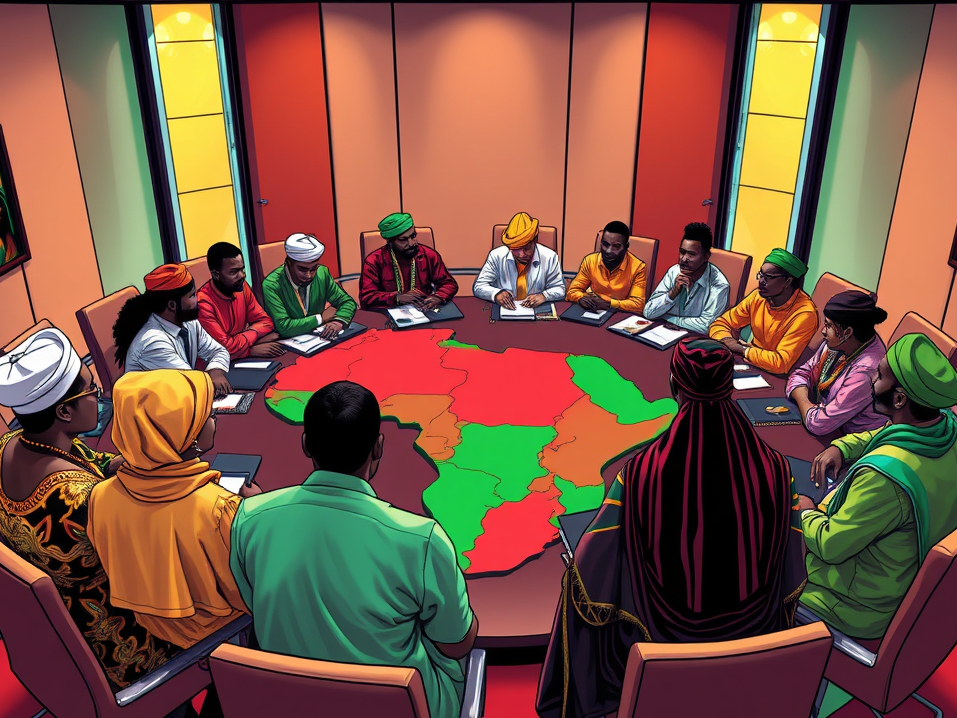
Oh, Africa, the damsel in distress of the present age. Everyone wants to save you. But from what? If we’re being honest with ourselves, that’s the long-standing narrative, oftentimes a subtle expression of the game of interests concerning the vast potential of the continent. It’s not saving, it’s seizing opportunity; however, the narrative is everything. A wise African proverb says, until the lion learns to write, every story will glorify the hunter.
This prevailing narrative, heavily influenced by the sources of capital, perpetuates a dependency that was acutely exposed during the recent funding winter. While African startups experienced a sharper decline in deals—a 52% fall between 2022 and 2024—compared to other regions, as global venture capital (VC) flows contracted, the full-year 2025 data reveal a market that has plateaued. This exposed the inherent vulnerabilities of an ecosystem over-reliant on external funding.
It also presented an opportunity to learn and form a mature ecosystem.
The consequence
An ecosystem heavily dependent on external funding bears quite a few consequences. Greatest of all, the funding becomes the prize, the success, rather than a tool for achieving it. This makes foreign funders and founders predominantly and prematurely portrayed as the heroes of this continent, which is unfair to them and the local resources. We forget problems aren’t solved by throwing money at them.
Mindset
Yet the true homegrown stories easily go under the radar. Listen, foreign funding isn’t the enemy. The dependence and the system are the issue. Such a highly-dependent ecosystem shapes the mentalities of a dynamic demographic of youthful problem solvers, where it’s easy to believe that foreign investment is the one sure path to success.
And it’s easy to lose focus on true problems that need resolving to meet the requirements of teams that aren’t aligned with local culture, just to satisfy investor narratives and close funding deals.
When this happens, are we really solving problems? Or are we creating even more narratives painting intent to change the world, but masking our intentions of simply scaling, turning profits, and exiting?
Hot air overload
Is it just me, or do you also often read brand messaging for a huge number of organizations and get excited because it seems like they’re tackling huge problems, the right problems… only to get deflated when the problems in reality remain unchanged?
But blogs concerning progress, milestones, achievements, and closed funding rounds with obscene amounts continue to proliferate your interface, left, right, and center?
This is exactly how media is saturated with exaggerated mission and vision statements, blogs, and other brand messaging that sweeps emotion.
Trend of cautionary tales
And that’s not the worst part. See these exciting startups and ideas? You really want them to succeed. It hurts that after a while, you hear of some of the most promising ones again, not as success stories, but cautionary tales. They had such potential. But now, the problem remains, the solvers down and out, money lost.
I acknowledge there are a variety of factors that can lead to the above outcome. But my focus is on those where the dynamic of funding, problem, and teams is off, leading to hot air that paints the next unicorn as being in the works, only to have products and services that fail the test of time in a unique African ecosystem.
The goal is by no means to exclude foreign investment; it’s more than a vital component of growth. However, based on the global economic conditions and their impact on venture capital flows, we need to re-evaluate the funding models of the African startup. The ecosystem needs to be reset and rebalanced.
See the ill-fitting patterns!
So, what should we do? First things first, as change makers, we need to not just think outside the box, but do away with it entirely. Again, the issue isn’t foreign funding, but the systems behind the funds. They may have worked in their native parts of the world, but 1:1 mapping to other regions of the globe yields strain.
I particularly like what Tony Elumelu recently said, speaking at the launch of the 2026 Tony Elumelu Foundation launch, “Africa’s greatest asset is our people,” He said. “Africa does not need aid; Africa needs investment—in infrastructure, in institutions, but most critically in our young.”
This expresses a mindset that needs to be urgently assimilated. Moving from a continent portrayed as one with an outstretched hand begging for what passers-by have to spare, with every transaction giving it a reason to stay seated and stretch out the hand once again, to one that takes a hard look at itself and sees its ingenuity, competency, beauty, and influence.

We also need to move our perspectives from seeing investment as just devoting resources to yield money, to devoting resources such as money, time, energy, effort, and expertise into something to expect a worthwhile result. The worthwhile result needs to be a reflection of the needs of the continent.
Breaking patterns and committing to change
The narrative needs to change. From prioritizing the two birds in the bush to the bird in hand.
The data points to historical biases of external funders, where data shows they often favor relationships with countries with shared colonial linkages or common languages. This tendency has concentrated capital in the “Big Four” markets—Nigeria, Egypt, Kenya, and South Africa, which received a cumulative total of 82% of Africa’s venture funding.
We see a trend of a significant sectoral mismatch. Traditional VCs, optimized for asset-light, high-growth tech (e.g., fintech, which received 75% of funding to African founders between 2019 and 2023, and approximately half of disclosed start-up funding by 2025), often underfund key sectors for African development like agri-tech and health tech because of misaligned expectations of rapid growth and quick exits.
This imported VC framework has yielded tales of mismatch across the continent. Africa often favors infrastructure-heavy and long-term development-oriented opportunities.
Refusing to conform means actively building and celebrating not just a narrative, but the truth, driven by African solutions for unique African problems. And this doesn’t by any means mean sidelining any resource outside of Africa; it just means having a shift in perspective where the lens of the problems is the one presented by those who’ve recognized the true pain points and look to implement effective solutions, rather than localize solutions and frameworks that just don’t fit in the long term.
Did you know that African investors now constitute the single largest group of active participants in African venture capital deals? They comprised at least 30% of active VCs as of 2024. This growing local investor base, combined with the increasing interest in sectors such as climate tech, healthcare, and agri tech, reveals a powerful pattern of self-determination and alignment with the continent’s needs.
Reworking mindsets
The journey for African founders is often fraught with unique challenges. In particular, when facing expectations of traditional VC models that often turn out to be incompatible with local market realities.
Navigating funding stages
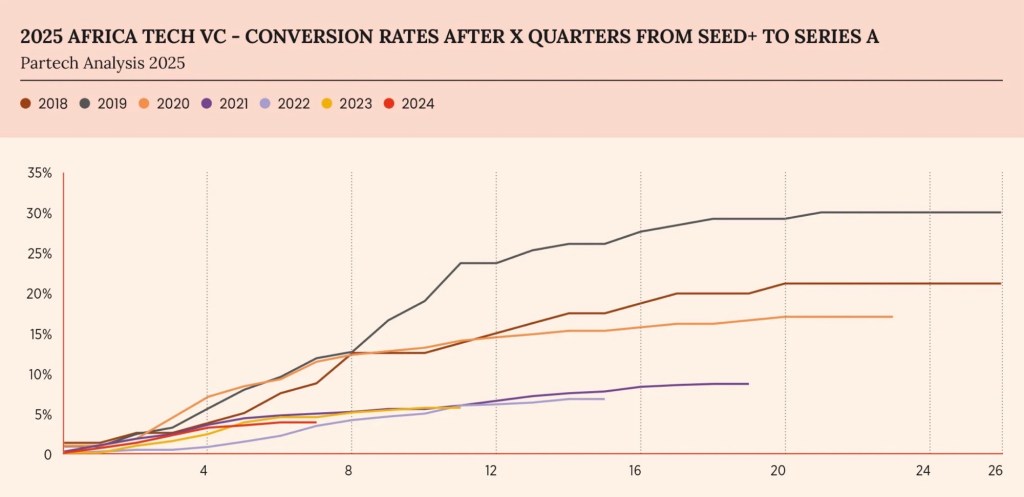
One critical area that demands aggressive education for African founders is understanding the nuances of funding stages and the imperative for achieving early profitability. Founder, do you know what you’re signing off on at each stage? Do you really know? The Series A crunch is a stark reality: the conversion rate from seed to Series A notably plummeted from a peak of 35% for the 2019 cohort to a low of a mere 5% for the 2023 cohort, with marginal recovery in subsequent cohorts. As an early-stage company, you’re compelled to prioritize profitability sooner rather than later.
Founder, don’t compromise on the problem you’re solving for money. It comes back to bite you down the line. Funder, truly curate your models (and approach to funding stages) to truly understand the problems and respond with resource outlay that best ensures value.
Capital types and attracting the right partners
Founder, you need to be equipped with the knowledge of various capital types. While foreign VCs typically deploy larger checks, previously accounting for approximately three-quarters of funding value, a growing number of African investors are becoming active, as mentioned in the previous section.
These indigenous VCs and angel networks, such as ABAN and female-focused groups like Rising Tide Africa and FirstCheck Africa, often provide smart capital rooted in deep local market understanding, mentorship, and long-term commitment that goes beyond mere financial injection.
We need to move beyond satisfaction with the problem -> capital approach. This applies to both investors and startups. A common problem doesn’t make you the right fit any more than things in common make people soulmates. Your goals and value systems, among others, count to make the right fit. We need to identify, attract, and strategically partner with players to secure partnerships, manpower, and capital that align with our missions and the continent’s unique development trajectory.
We need systems that are a better fit
Beyond education, we can eliminate ill-fitting funding models entirely. They aren’t a one-size-fits-all solution for such a diverse entrepreneurial landscape. What should we do in their place? Create and scale systems that are intrinsically better suited to Africa’s unique market characteristics and long-term development goals.
This involves aggressively promoting and expanding alternative, non-dilutive financing pathways that empower founders and foster sustainable growth.
One such crucial mechanism is venture debt, which surged to $1.6 billion in 2025 from $1.01 billion in 2024, representing a substantial 63% increase. This signals a growing preference for capital that allows startups to extend their runway and finance asset-heavy models without relinquishing equity.
Similarly, revenue-based financing (RBF) is gaining traction, providing flexible, non-dilutive funding in exchange for a percentage of future revenue, aligning payments with a company’s actual earnings. Companies like Pesapal (Kenya), before receiving strategic minority investment by KCB Group, demonstrated the power of successful bootstrapping (self-funding through sustained revenue) over one and a half decades to maintain control and achieve market dominance.
Beyond these, grants and competitions (like the Tony Elumelu Foundation, which has disbursed over $100 million to more than 24,000 entrepreneurs), corporate partnerships (e.g., Safaricom’s M-Pesa collaborations), and even microfinance and SME loans from local banks are proving to be viable and often more appropriate capital sources. The rise of DeFi and crypto-based funding also offers fast, global access without traditional banking barriers.
A cornerstone of building better systems is strengthening local financial institutions and capital markets. There’s immense untapped potential in African institutional funds, particularly sovereign wealth funds, pension funds, and insurance companies.
“Africa is not poor. Our institutional investors – pension funds, sovereign wealth funds, insurance companies, and even central banks – together manage more than USD 2.1 trillion in assets,” said Solomon Quaynor, the African Development Bank Group’s Vice-President for Private Sector, Infrastructure & Industrialization, during the AFDB 2025 Annual meetings. “If just 5 percent of these funds were directed towards infrastructure and the private sector, it would unlock more than USD 100 billion in long-term capital for the continent.”
Analysis suggests that if African pension funds, which hold at least $600 billion, allocated just a fraction of their current holdings to infrastructure, it could unlock billions of dollars of additional financing annually. Initiatives like Nigeria’s InfraCredit and Africa50’s Infrastructure Acceleration Fund demonstrate the feasibility of mobilizing this domestic capital. By creating and bolstering these tailored systems, Africa can move beyond dependence, building a resilient funding ecosystem that truly reflects its unique economic landscape and entrepreneurial spirit.
However, even the right system on paper, with the wrong components, yields the wrong results. Just because a stakeholder is native may not mean they’re right, and the converse applies. I’ve met foreigners with a greater heart for a region than natives. Do your due diligence. It’s about those who have a heart to solve the right problems.
All this is not to ignore the role that governments, policies, and political will play in the funding landscape, with evidence of the recently shut-down KOKO Networks in Kenya. But that’s a conversation for another day.
Lion, write!
Remember, the contention isn’t about who’s indigenous and who’s not. It’s about acknowledging that not all problems can be seen through the same lens, and solution frameworks aren’t a one-size-fits-all. Then developing ones that work, based on the uniqueness of the region. This is how we rewrite the narrative.
The continent cries out for those who’ll truly and objectively see its unique ails and work to truly restore it, local or foreign. Where are the voices of the sons and daughters of Africa? The creativity of the experienced and seasoned? Vision and ambition of the young? True desire for change by global stakeholders? The time for the lion to write has come.



 tabiri